Most investment platform scripts are built for end users. The interface looks polished, the onboarding is smooth, and the feature list looks impressive on a sales page. But the moment a developer tries to connect it to something — a payment gateway, a price feed, a third-party wallet, a custom mobile app — the cracks appear. Undocumented endpoints. Hardcoded dependencies. No webhook support. A platform that looked launch-ready becomes a months-long integration headache.
That’s the difference a developer-friendly investment script with proper API documentation makes. And for anyone serious about launching a HYIP or crypto investment platform in 2026, it’s not a nice-to-have — it’s the foundation everything else is built on.
Here’s what that actually looks like in practice.
What Is an Investment Script — and Why Does the API Layer Matter?
An investment script is a ready-built software foundation for a crypto or HYIP investment platform. It handles the core mechanics — user registration, deposit and withdrawal flows, investment plan management, automated interest disbursement, referral systems, and admin dashboards — so you’re not building those from scratch.
The API layer is what determines whether that script is a truly extensible platform or just a closed box with a nice frontend. A well-documented API means any developer — in-house, freelance, or from a partner company — can connect external services, automate workflows, and build on top of the platform without reverse-engineering the core system or waiting on the vendor for every change.
Without solid API documentation, every integration becomes a negotiation. With it, the platform grows on your schedule and your terms.
What a Developer-Friendly Investment Script Should Support
Not all investment scripts are built the same. The ones worth deploying share a common set of API capabilities that make integration straightforward rather than painful.
User and account management endpoints let external systems — KYC providers, CRMs, email marketing platforms — read and write user data without manual exports. Registration, authentication, profile updates, and verification status should all be accessible via clean, documented REST calls with predictable response structures.
Deposit and withdrawal APIs are where most integration complexity lives. A properly built investment script exposes these as webhook-enabled operations — so payment processors, crypto gateways, and wallet systems can push transaction events in real time rather than relying on polling or manual reconciliation. Support for Bitcoin, Ethereum, TRON/TRC20, Perfect Money, and other major gateways should be built in, not bolted on.
Investment plan and returns endpoints allow external tools and custom dashboards to query plan configurations, user allocations, and calculated returns programmatically. This is essential for building mobile apps, investor portals, or reporting tools that sit on top of the core platform without touching the codebase directly.
Referral and affiliate system APIs give marketing tools and affiliate platforms the data they need to track commissions, tier performance, and payout status — automatically and in real time.
Webhook support is what separates a reactive platform from an event-driven one. When a deposit confirms, a withdrawal completes, or a return is credited, outbound webhooks notify connected systems instantly — enabling automations that would otherwise require constant polling or manual work.
Why Documentation Quality Is a Signal of Code Quality
Documentation quality tells you a lot about how a script was built. If the API docs are vague, incomplete, or just a list of endpoints with no examples, that’s usually a reflection of how the underlying codebase was structured — as an afterthought, not a product.
Good API documentation includes clearly structured endpoint references with real request and response examples, error code definitions with troubleshooting guidance, authentication and rate limiting details, sandbox or staging environments for integration testing, and code samples in common languages. A developer should be able to go from reading the docs to making their first successful API call in under an hour — without opening a support ticket.
When documentation meets that bar, integrations get done faster, custom features ship on schedule, and the platform becomes genuinely extensible rather than perpetually dependent on the vendor for every change.
What This Means for HYIP Platform Operators
For entrepreneurs launching a HYIP or crypto investment platform, the API layer isn’t just a developer concern — it’s a business concern. A platform that can integrate with any payment processor, KYC provider, or analytics tool is a platform that can adapt to new markets, new compliance requirements, and new user expectations without starting over.
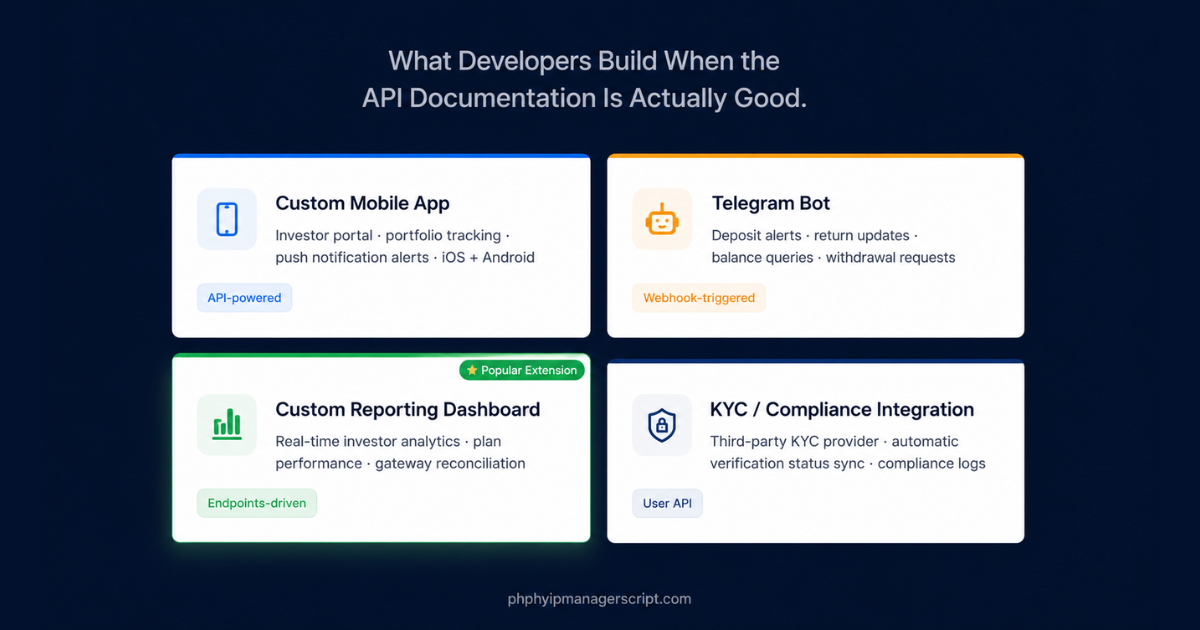
It also means your development team — whoever that is — can build on top of your platform instead of being blocked by it. Custom investor dashboards, mobile apps, Telegram bots, automated reporting — all of these become straightforward when the API is clean and the documentation is real.
LaraHYIP, built on Laravel 11 and PHP 8, is designed with exactly this in mind. The platform ships with comprehensive API documentation covering all core investment operations, multi-gateway payment integration, webhook support, and a modular architecture that makes custom development predictable rather than painful. With full source code ownership and free installation, you’re not locked into a vendor relationship — you own the platform and can extend it however your business requires.
If you’re ready to launch an investment platform that developers can actually build on, explore LaraHYIP and get started today — or get in touch with the NX team to discuss your requirements.