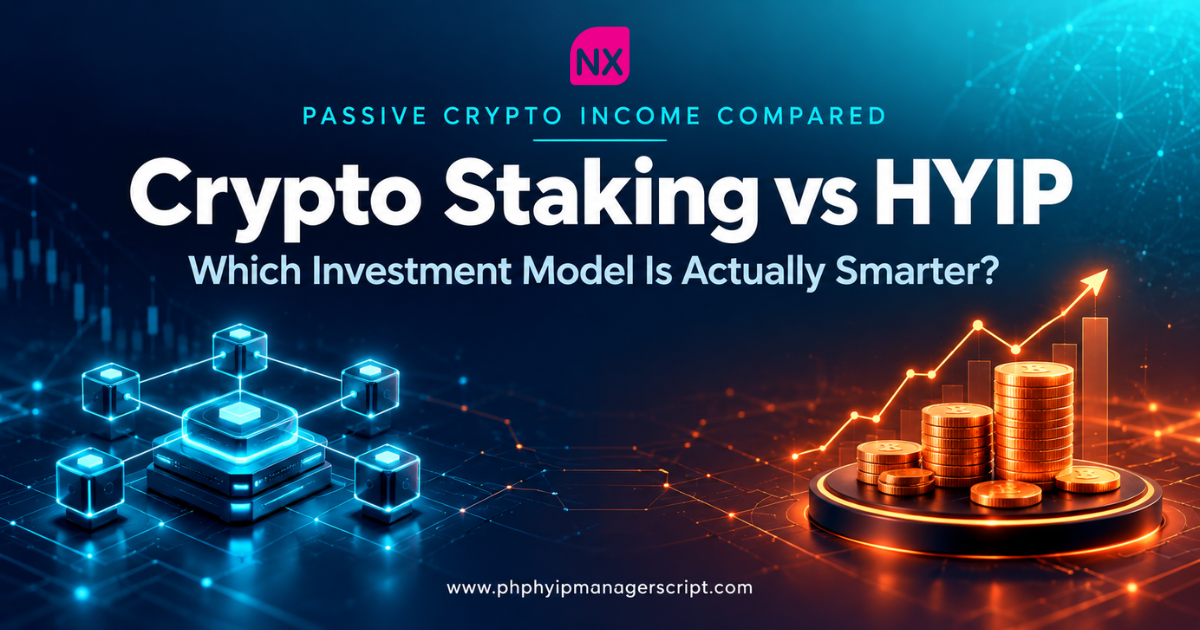
Both crypto staking and HYIP investing get pitched as ways to earn passive returns on cryptocurrency holdings, and both attract investors looking for yield without active trading. But the mechanics behind each are fundamentally different, and understanding that difference is the key to evaluating either one honestly rather than comparing headline percentages alone.
What Is Crypto Staking?
Staking is the process of locking up cryptocurrency to help support the operations of a Proof-of-Stake (PoS) blockchain network — validating transactions, securing the network, and maintaining consensus. In exchange for locking up tokens and participating in this validation process, stakers earn rewards, typically paid in the same token being staked.
The reward mechanism is defined directly by the blockchain protocol itself, not by an individual platform operator. Ethereum, Cardano, Solana, and many other major networks use staking as their core security mechanism, meaning the reward structure is transparent, protocol-level, and independently verifiable by anyone reviewing the network’s public rules.
What Is HYIP Investing?
A HYIP (High Yield Investment Program) is a platform promising fixed, often daily or weekly, returns on deposited funds. Unlike staking, the return isn’t generated by supporting a blockchain’s actual consensus mechanism — it’s defined by the platform operator, typically configured through an investment plan builder that sets interest rates, payout frequency, and compounding rules directly.
Side-by-Side Comparison
| Factor | Crypto Staking | HYIP Investing |
|---|---|---|
| Return source | Blockchain protocol rewards for network validation | Platform-defined fixed schedule |
| Who sets the reward rate | The blockchain protocol itself | The platform operator |
| Transparency | Publicly verifiable via blockchain explorers | Depends entirely on operator disclosure |
| Custody | Often non-custodial (self-staking) or custodial (exchange staking) | Typically custodial — platform holds the funds |
| Lock-up period | Protocol-defined, sometimes with unbonding periods | Platform-defined, varies by plan |
| Risk type | Slashing penalties, token price volatility, validator downtime | Operator insolvency, fraud, unsustainable payout structure |
How Staking Rewards Are Actually Calculated
Staking rewards are typically a function of several protocol-level variables: the total amount of the token staked network-wide, the network’s defined annual reward rate, and sometimes validator performance (uptime, correct participation in consensus). None of these variables are set by an individual investment platform — they’re embedded in the blockchain’s own rules, which is why staking rewards can generally be checked and verified independently of any single operator’s claims.
This is a meaningfully different trust model than a HYIP, where the promised return exists because the operator states it does, calculated and distributed according to internal, typically non-public logic.
Key Risks Compared
Crypto Staking Risks
- Slashing — some networks penalize validators (and by extension, delegators) for downtime or malicious behavior, resulting in a partial loss of staked funds
- Token price volatility — even a healthy staking reward rate can result in a net loss if the underlying token’s price falls significantly during the staking period
- Lock-up/unbonding periods — many networks require a waiting period before staked funds can be withdrawn, during which price movement can’t be reacted to
- Custodial exchange risk — staking through a centralized exchange reintroduces counterparty risk, since the exchange controls the underlying funds
HYIP Investing Risks
- Operator dependency — the entire return depends on the platform continuing to honor its payout schedule
- Unsustainable payout models — if returns paid to existing investors are funded primarily by new investor deposits, the model can only continue as long as new deposits keep flowing in
- Limited recourse — recovering funds from a platform that stops paying out is often difficult, particularly with anonymous or offshore operators
Verifiability Is the Core Difference
The single most useful lens for comparing these two models is verifiability. With staking, you can check a blockchain explorer, confirm the network’s current staking reward rate, and verify your own rewards arriving on-chain — independent of trusting any single company’s word. With a HYIP, verifying the return’s sustainability requires trusting the operator’s internal accounting, since the payout logic typically isn’t independently auditable unless the platform has specifically built its system around transparent smart contract integration.
This doesn’t automatically make every HYIP untrustworthy, but it does mean the burden of due diligence is considerably higher, since there’s no protocol-level rule enforcing the payout the way there is with staking.
Where the Two Models Sometimes Overlap
Some newer investment platforms have started incorporating staking-like mechanics into their structure — locking user funds for a defined period in exchange for a fixed return, marketed using staking terminology even when the underlying mechanism is closer to a traditional fixed-term investment plan than actual blockchain validation. If you’re evaluating a platform using this language, it’s worth asking directly whether returns come from actual network staking rewards or from an internally defined payout schedule dressed in staking terminology. Platforms genuinely integrating DeFi and traditional finance models should be able to clearly explain which portion of any advertised yield comes from each source.
Questions to Ask Before Choosing Either Model
- Can the reward rate be independently verified? Staking rates are checkable on public blockchain explorers; HYIP rates typically are not.
- Who controls the funds during the investment period? Self-custodial staking keeps you in control of your keys; most HYIPs require depositing funds directly to the operator.
- What happens if the network or platform experiences problems? Staking carries defined, protocol-level risks like slashing; HYIPs carry operator-level risks that are harder to predict in advance.
- Is the advertised return realistic relative to the asset’s actual network staking rate? A platform offering returns dramatically higher than the underlying network’s real staking yield is generating that extra return from somewhere else — worth understanding exactly where.
Frequently Asked Questions
Is crypto staking guaranteed to be profitable?
No. While the reward mechanism is protocol-verified, token price volatility can still result in a net loss even with a positive staking reward rate, since the token’s market value can fall by more than the reward earned.
Can I lose my staked funds entirely?
Under normal conditions, staked funds aren’t typically lost outright, though slashing penalties for validator misbehavior or downtime can reduce your staked balance. Token price declines can also significantly reduce the real-world value of your position.
Is staking through an exchange the same as self-staking?
Not exactly. Self-staking (running or delegating to your own validator) keeps you in control of your private keys, while staking through a centralized exchange means the exchange holds custody of your funds, reintroducing counterparty risk similar in category, though not identical in mechanism, to HYIP custodial risk.
Why do some HYIP platforms use the word “staking” in their marketing?
The term has become popular partly because of its association with legitimate, protocol-verified returns. Some platforms use it to describe fixed-term deposit plans that aren’t actually tied to blockchain validation, which is why it’s worth clarifying the actual reward mechanism rather than relying on terminology alone.
Which model is better for a first-time crypto investor?
Staking on an established, major network generally offers more transparency and independently verifiable mechanics, making it easier for a newer investor to evaluate. Any high-yield platform promising fixed returns significantly above verified network staking rates warrants considerably more scrutiny before committing funds.
Final Thoughts
Crypto staking and HYIP investing both promise passive returns, but one is enforced by transparent, protocol-level rules that anyone can verify, while the other depends on trusting a platform operator’s internal payout logic. Neither category is automatically safe or unsafe, but the verifiability gap between them is real and worth treating as the central question in any evaluation, not an afterthought to the advertised interest rate.